# tf.gather
|---|
| [ View source on GitHub](https://github.com/tensorflow/tensorflow/blob/v2.13.1/tensorflow/python/ops/array_ops.py#L5141-L5155) |
Gather slices from params axis `axis` according to indices. (deprecated arguments)
tf.gather(
params, indices, validate_indices=None, axis=None, batch_dims=0, name=None
)
> [!WARNING]
> **Deprecated:** SOME ARGUMENTS ARE DEPRECATED: `(validate_indices)`. They will be removed in a future version. Instructions for updating: The `validate_indices` argument has no effect. Indices are always validated on CPU and never validated on GPU.
Gather slices from `params` axis `axis` according to `indices`. `indices`
must be an integer tensor of any dimension (often 1-D).
[`Tensor.getitem`](https://www.tensorflow.org/versions/r2.13/api_docs/python/tf/Tensor#__getitem__) works for scalars, [`tf.newaxis`](https://www.tensorflow.org/versions/r2.13/api_docs/python/tf#newaxis), and
[python slices](https://numpy.org/doc/stable/reference/arrays.indexing.html#basic-slicing-and-indexing)
[`tf.gather`](https://www.tensorflow.org/versions/r2.13/api_docs/python/tf/gather) extends indexing to handle tensors of indices.
In the simplest case it's identical to scalar indexing:
params = tf.constant(['p0', 'p1', 'p2', 'p3', 'p4', 'p5'])
params[3].numpy()
b'p3'
tf.gather(params, 3).numpy()
b'p3'
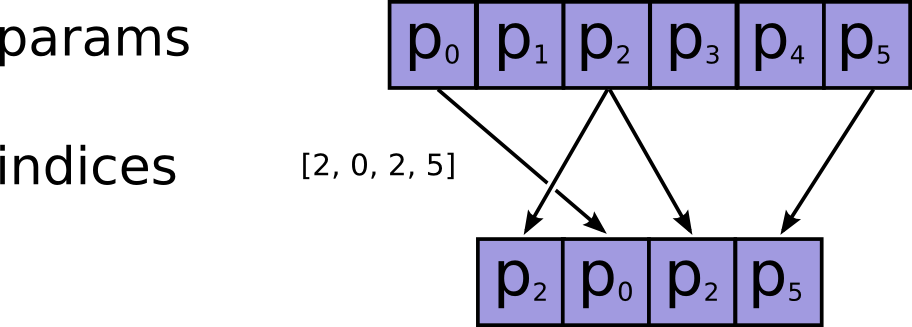
The most common case is to pass a single axis tensor of indices (this
can't be expressed as a python slice because the indices are not sequential):
indices = [2, 0, 2, 5]
tf.gather(params, indices).numpy()
array([b'p2', b'p0', b'p2', b'p5'], dtype=object)
The indices can have any shape. When the `params` has 1 axis, the
output shape is equal to the input shape:
tf.gather(params, [[2, 0], [2, 5]]).numpy()
array([[b'p2', b'p0'],
[b'p2', b'p5']], dtype=object)
The `params` may also have any shape. `gather` can select slices
across any axis depending on the `axis` argument (which defaults to 0).
Below it is used to gather first rows, then columns from a matrix:
params = tf.constant([[0, 1.0, 2.0],
[10.0, 11.0, 12.0],
[20.0, 21.0, 22.0],
[30.0, 31.0, 32.0]])
tf.gather(params, indices=[3,1]).numpy()
array([[30., 31., 32.],
[10., 11., 12.]], dtype=float32)
tf.gather(params, indices=[2,1], axis=1).numpy()
array([[ 2., 1.],
[12., 11.],
[22., 21.],
[32., 31.]], dtype=float32)
More generally: The output shape has the same shape as the input, with the
indexed-axis replaced by the shape of the indices.
def result_shape(p_shape, i_shape, axis=0):
return p_shape[:axis] + i_shape + p_shape[axis+1:]
result_shape([1, 2, 3], [], axis=1)
[1, 3]
result_shape([1, 2, 3], [7], axis=1)
[1, 7, 3]
result_shape([1, 2, 3], [7, 5], axis=1)
[1, 7, 5, 3]
Here are some examples:
params.shape.as_list()
[4, 3]
indices = tf.constant([[0, 2]])
tf.gather(params, indices=indices, axis=0).shape.as_list()
[1, 2, 3]
tf.gather(params, indices=indices, axis=1).shape.as_list()
[4, 1, 2]
params = tf.random.normal(shape=(5, 6, 7, 8))
indices = tf.random.uniform(shape=(10, 11), maxval=7, dtype=tf.int32)
result = tf.gather(params, indices, axis=2)
result.shape.as_list()
[5, 6, 10, 11, 8]
This is because each index takes a slice from `params`, and
places it at the corresponding location in the output. For the above example
# For any location in indices
a, b = 0, 1
tf.reduce_all(
# the corresponding slice of the result
result[:, :, a, b, :] ==
# is equal to the slice of `params` along `axis` at the index.
params[:, :, indices[a, b], :]
).numpy()
True
### Batching:
The `batch_dims` argument lets you gather different items from each element
of a batch.
Using `batch_dims=1` is equivalent to having an outer loop over the first
axis of `params` and `indices`:
params = tf.constant([
[0, 0, 1, 0, 2],
[3, 0, 0, 0, 4],
[0, 5, 0, 6, 0]])
indices = tf.constant([
[2, 4],
[0, 4],
[1, 3]])
tf.gather(params, indices, axis=1, batch_dims=1).numpy()
array([[1, 2],
[3, 4],
[5, 6]], dtype=int32)
#### This is equivalent to:
def manually_batched_gather(params, indices, axis):
batch_dims=1
result = []
for p,i in zip(params, indices):
r = tf.gather(p, i, axis=axis-batch_dims)
result.append(r)
return tf.stack(result)
manually_batched_gather(params, indices, axis=1).numpy()
array([[1, 2],
[3, 4],
[5, 6]], dtype=int32)
Higher values of `batch_dims` are equivalent to multiple nested loops over
the outer axes of `params` and `indices`. So the overall shape function is
def batched_result_shape(p_shape, i_shape, axis=0, batch_dims=0):
return p_shape[:axis] + i_shape[batch_dims:] + p_shape[axis+1:]
batched_result_shape(
p_shape=params.shape.as_list(),
i_shape=indices.shape.as_list(),
axis=1,
batch_dims=1)
[3, 2]
tf.gather(params, indices, axis=1, batch_dims=1).shape.as_list()
[3, 2]
This comes up naturally if you need to use the indices of an operation like
[`tf.argsort`](https://www.tensorflow.org/versions/r2.13/api_docs/python/tf/argsort), or [`tf.math.top_k`](https://www.tensorflow.org/versions/r2.13/api_docs/python/tf/math/top_k) where the last dimension of the indices
indexes into the last dimension of input, at the corresponding location.
In this case you can use `tf.gather(values, indices, batch_dims=-1)`.
#### See also:
- [`tf.Tensor.getitem`](https://www.tensorflow.org/versions/r2.13/api_docs/python/tf/Tensor#__getitem__): The direct tensor index operation (`t[]`), handles scalars and python-slices `tensor[..., 7, 1:-1]`
- `tf.scatter`: A collection of operations similar to `__setitem__` (`t[i] = x`)
- [`tf.gather_nd`](https://www.tensorflow.org/versions/r2.13/api_docs/python/tf/gather_nd): An operation similar to [`tf.gather`](https://www.tensorflow.org/versions/r2.13/api_docs/python/tf/gather) but gathers across multiple axis at once (it can gather elements of a matrix instead of rows or columns)
- [`tf.boolean_mask`](https://www.tensorflow.org/versions/r2.13/api_docs/python/tf/boolean_mask), [`tf.where`](https://www.tensorflow.org/versions/r2.13/api_docs/python/tf/where): Binary indexing.
- [`tf.slice`](https://www.tensorflow.org/versions/r2.13/api_docs/python/tf/slice) and [`tf.strided_slice`](https://www.tensorflow.org/versions/r2.13/api_docs/python/tf/strided_slice): For lower level access to the implementation of `__getitem__`'s python-slice handling (`t[1:-1:2]`)
| ## Args ||
|---|---|
| `params` | The `Tensor` from which to gather values. Must be at least rank `axis + 1`. |
| `indices` | The index `Tensor`. Must be one of the following types: `int32`, `int64`. The values must be in range `[0, params.shape[axis])`. |
| `validate_indices` | Deprecated, does nothing. Indices are always validated on CPU, never validated on GPU.
> [!CAUTION] > **Caution:** On CPU, if an out of bound index is found, an error is raised. On GPU, if an out of bound index is found, a 0 is stored in the corresponding output value. |
| `axis` | A `Tensor`. Must be one of the following types: `int32`, `int64`. The `axis` in `params` to gather `indices` from. Must be greater than or equal to `batch_dims`. Defaults to the first non-batch dimension. Supports negative indexes. |
| `batch_dims` | An `integer`. The number of batch dimensions. Must be less than or equal to `rank(indices)`. |
| `name` | A name for the operation (optional). |
| ## Returns ||
|---|---|
| A `Tensor`. Has the same type as `params`. ||