# tf.raw_ops.DynamicStitch
Interleave the values from the `data` tensors into a single tensor.
#### View aliases
**Compat aliases for migration**
See
[Migration guide](https://www.tensorflow.org/guide/migrate) for
more details.
[`tf.compat.v1.raw_ops.DynamicStitch`](https://www.tensorflow.org/api_docs/python/tf/raw_ops/DynamicStitch)
tf.raw_ops.DynamicStitch(
indices, data, name=None
)
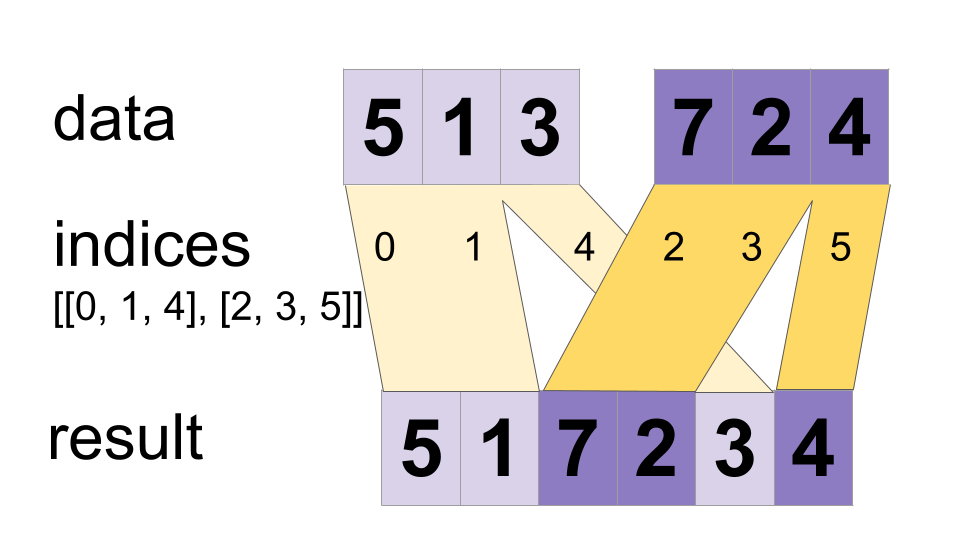
Builds a merged tensor such that
merged[indices[m][i, ..., j], ...] = data[m][i, ..., j, ...]
For example, if each `indices[m]` is scalar or vector, we have
# Scalar indices:
merged[indices[m], ...] = data[m][...]
# Vector indices:
merged[indices[m][i], ...] = data[m][i, ...]
Each `data[i].shape` must start with the corresponding `indices[i].shape`,
and the rest of `data[i].shape` must be constant w.r.t. `i`. That is, we
must have `data[i].shape = indices[i].shape + constant`. In terms of this
`constant`, the output shape is
merged.shape = [max(indices)] + constant
Values are merged in order, so if an index appears in both `indices[m][i]` and
`indices[n][j]` for `(m,i) < (n,j)` the slice `data[n][j]` will appear in the
merged result. If you do not need this guarantee, ParallelDynamicStitch might
perform better on some devices.
#### For example:
indices[0] = 6
indices[1] = [4, 1]
indices[2] = [[5, 2], [0, 3]]
data[0] = [61, 62]
data[1] = [[41, 42], [11, 12]]
data[2] = [[[51, 52], [21, 22]], [[1, 2], [31, 32]]]
merged = [[1, 2], [11, 12], [21, 22], [31, 32], [41, 42],
[51, 52], [61, 62]]
This method can be used to merge partitions created by `dynamic_partition`
as illustrated on the following example:
# Apply function (increments x_i) on elements for which a certain condition
# apply (x_i != -1 in this example).
x=tf.constant([0.1, -1., 5.2, 4.3, -1., 7.4])
condition_mask=tf.not_equal(x,tf.constant(-1.))
partitioned_data = tf.dynamic_partition(
x, tf.cast(condition_mask, tf.int32) , 2)
partitioned_data[1] = partitioned_data[1] + 1.0
condition_indices = tf.dynamic_partition(
tf.range(tf.shape(x)[0]), tf.cast(condition_mask, tf.int32) , 2)
x = tf.dynamic_stitch(condition_indices, partitioned_data)
# Here x=[1.1, -1., 6.2, 5.3, -1, 8.4], the -1. values remain
# unchanged.
| ## Args ||
|---|---|
| `indices` | A list of at least 1 `Tensor` objects with type `int32`. |
| `data` | A list with the same length as `indices` of `Tensor` objects with the same type. |
| `name` | A name for the operation (optional). |
| ## Returns ||
|---|---|
| A `Tensor`. Has the same type as `data`. ||