# tf.raw_ops.ResourceScatterMax
Reduces sparse updates into the variable referenced by `resource` using the `max` operation.
#### View aliases
**Compat aliases for migration**
See
[Migration guide](https://www.tensorflow.org/guide/migrate) for
more details.
[`tf.compat.v1.raw_ops.ResourceScatterMax`](https://www.tensorflow.org/api_docs/python/tf/raw_ops/ResourceScatterMax)
tf.raw_ops.ResourceScatterMax(
resource, indices, updates, name=None
)
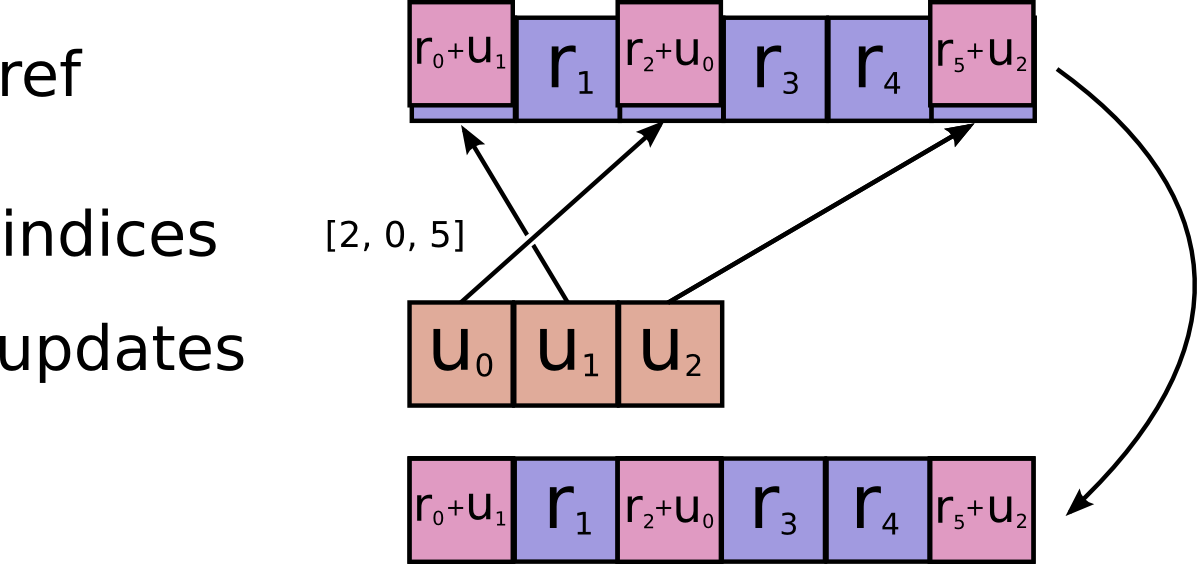
This operation computes
# Scalar indices
ref[indices, ...] = max(ref[indices, ...], updates[...])
# Vector indices (for each i)
ref[indices[i], ...] = max(ref[indices[i], ...], updates[i, ...])
# High rank indices (for each i, ..., j)
ref[indices[i, ..., j], ...] = max(ref[indices[i, ..., j], ...], updates[i, ..., j, ...])
Duplicate entries are handled correctly: if multiple `indices` reference
the same location, their contributions are combined.
Requires `updates.shape = indices.shape + ref.shape[1:]` or `updates.shape = []`.
| ## Args ||
|---|---|
| `resource` | A `Tensor` of type `resource`. Should be from a `Variable` node. |
| `indices` | A `Tensor`. Must be one of the following types: `int32`, `int64`. A tensor of indices into the first dimension of `ref`. |
| `updates` | A `Tensor`. Must be one of the following types: `float32`, `float64`, `int32`, `uint8`, `int16`, `int8`, `complex64`, `int64`, `qint8`, `quint8`, `qint32`, `bfloat16`, `qint16`, `quint16`, `uint16`, `complex128`, `half`, `uint32`, `uint64`. A tensor of updated values to add to `ref`. |
| `name` | A name for the operation (optional). |
| ## Returns ||
|---|---|
| The created Operation. ||